
1. Understanding Social Security Solvency Solutions
Social Security Solvency Solutions refer to structured policy approaches designed to ensure that social insurance programs remain financially sustainable over time. These systems depend on steady contributions from workers to fund benefits for retirees, disabled individuals, and survivors. When the balance between income and payouts weakens, governments must intervene to maintain stability.
In practice, Social Security Solvency Solutions aim to keep trust in retirement systems intact while ensuring that benefits continue without interruption. Because these programs support millions of households, even small financial imbalances can create long-term pressure on national budgets.
2. Why Social Security Solvency Solutions Matter for Economic Security
The importance of Social Security Solvency Solutions becomes clear when considering how deeply societies depend on these programs. For many retirees, social security payments are a primary source of income, covering essential needs such as housing, food, and healthcare.
Additionally, strong solvency planning supports broader economic stability. When citizens trust that retirement benefits will remain reliable, they make better long-term financial decisions. As a result, Social Security Solvency Solutions contribute not only to individual security but also to national economic confidence.
3. Demographic Shifts and Their Impact on Funding Pressure
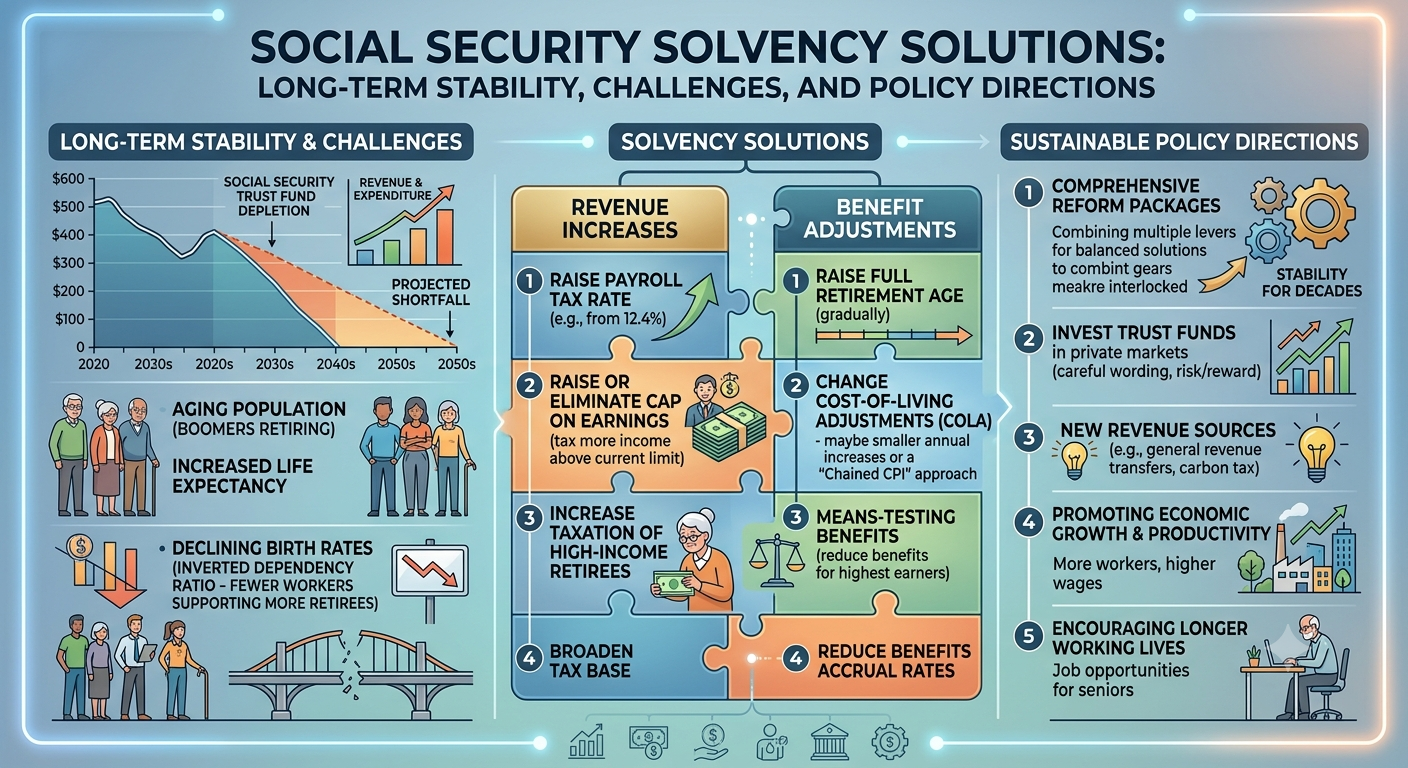
One of the most significant challenges facing Social Security Solvency Solutions is population aging. As life expectancy increases and birth rates decline in many regions, fewer workers are supporting a growing retired population.
This shift increases the strain on pay-as-you-go systems, where current workers fund current retirees. Over time, this imbalance makes it harder to maintain financial stability without policy adjustments. Therefore, demographic change remains a central issue in discussions about Social Security Solvency Solutions.
4. Economic Factors That Influence System Stability
Beyond demographics, economic conditions also shape the effectiveness of Social Security Solvency Solutions. Wage growth, inflation, and employment rates all directly affect payroll tax revenue, which funds these programs.
When wages stagnate or unemployment rises, contribution inflows slow down. At the same time, benefit obligations often increase due to cost-of-living adjustments. This combination creates funding pressure that policymakers must address through structural planning and reform.
5. Structural Gaps in Existing Social Security Systems
Many current systems were designed decades ago under very different assumptions about population growth and life expectancy. As a result, structural gaps have emerged over time. These gaps make it difficult for systems to remain fully balanced without ongoing intervention.
Social Security Solvency Solutions often focus on correcting these structural mismatches. Without updates, outdated formulas and eligibility rules can gradually widen funding deficits, creating long-term sustainability risks.
6. Early Adjustments Used in Social Security Solvency Solutions
Governments have already implemented several early-stage measures as part of Social Security Solvency Solutions. One common adjustment involves gradually increasing the retirement age, which reduces the number of years benefits are paid.
Another approach includes modifying payroll tax rates or expanding the taxable income base. These changes help increase system revenue, although they must be carefully balanced to avoid placing excessive pressure on workers and employers.
7. The Role of Benefit Formula Adjustments
Benefit calculations play a key role in shaping long-term system costs. Adjusting how benefits are calculated can significantly influence overall spending levels. For example, modifying cost-of-living adjustments or indexing formulas can help control future liabilities.
These changes are often politically sensitive but remain an important part of Social Security Solvency Solutions. Policymakers must balance fairness to retirees with the need to maintain long-term financial stability.
8. Payroll Tax Policies and Revenue Expansion Strategies
Payroll taxes remain the primary funding source for most social security systems. Therefore, changes to tax policy are central to Social Security Solvency Solutions. Increasing contribution rates or broadening the tax base can generate additional revenue.
However, these strategies must consider economic competitiveness and worker income levels. Sudden or large increases can affect employment costs, so gradual and balanced implementation is typically preferred.
9. Public Trust and Policy Communication Challenges
Public trust plays a major role in the success of any reform effort. If citizens believe that future benefits are uncertain, it can influence retirement planning and saving behavior. For this reason, clear communication is essential when discussing Social Security Solvency Solutions.
Governments must explain policy changes transparently and ensure that adjustments are perceived as fair and necessary. Without trust, even well-designed reforms may face resistance or misunderstanding.
10. Transition Toward Long-Term Stability Models
Many countries are now moving toward hybrid approaches that combine multiple reform strategies. These models may include retirement age adjustments, revenue reforms, and benefit recalibration working together.
Such combined strategies represent a more balanced approach to Social Security Solvency Solutions, allowing governments to spread adjustments across multiple areas rather than relying on a single measure.
Conclusion: Building Sustainable Social Security Solvency Solutions
Ensuring long-term stability requires consistent attention to both economic and demographic realities. Social Security Solvency Solutions are not one-time fixes but ongoing policy efforts that evolve with changing conditions.
Ultimately, sustainable systems depend on a combination of thoughtful policy design, transparent governance, and gradual adaptation. When these elements work together, Social Security Solvency Solutions can maintain reliable support for future generations while preserving financial stability for society as a whole.